
Hamed Farmand, founder and president of Children of Imprisoned Parents International and a member of the Global Prison Nursery Network
Originally published in Farsi at Radio Zamaneh on January 13, 2025
This report examines the situation of children and their mothers in the “Women’s Ward” (Andarzgãh-e Nesvãn) of Kermanshah. In a facility that fails to meet basic prison standards, children are kept alongside their mothers.
In this report, drawing on information available in official media, human rights organizations’ reports—including the most recent one dated May–June 2022 and an interview with a former political prisoner who was held in this facility between 1981 and 1983, I examine the situation of children and their mothers in the “Women’s Ward” (Andarzgah-e Nesvan) of Kermanshah.
This report is part of an ongoing series published by Radio Zamaneh on the situation of children in women’s wards and prisons across Iran. So far, the series has covered nine facilities: Kachooei Prison in Alborz provice (19 October 2023), Sepidar Prison in Khuzestan province (26 October 2023), Qarchak Prison in Tehran province (27 November 2023), Urmia Prison in West Azerbaijan province (19 January 2024), Lakan Prison in Gilan province (18 February 2024), Vakilabad Prison in Khorasan Razavi province (16 March 2024), Khorramabad Prison in Lorestan province (9 June 2024), Yasuj Prison in Kohgiluyeh and Boyer-Ahmad province (4 July 2024), and Evin Prison in Tehran province (5 September 2024).
Five hundred kilometers from the capital—out of sight of the media and human rights activists—dozens of women are held in a building adjacent to the Kermanshah Juvenile Correction and Rehabilitation Center. They are confined in an unsanitary environment, without proper air filtration, and far beyond the facility’s intended capacity. In a place that was never built for women prisoners—and that does not meet even the basic prison standards applicable to male inmates—children are also kept alongside their mothers.
Three Decades of Obscurity: From the 1979 Revolution to the Amended Islamic Penal Code in the 2010s
Until December 2013, when women prisoners from Kermanshah Province were transferred to a building adjacent to the Juvenile Correction and Rehabilitation Center—where boys are held—they had been confined in a ward inside Kermanshah Central Prison, Dizelãbad.
In September 2010, the Director-General of Kermanshah Province Prisons promised that, “in order to provide better services,” the women would be relocated to a new facility. He also stated that “attention to cultural and religious matters” would be among the improvements following the transfer.
However, according to available evidence and research—including a study conducted in September 2020 by the Strategic Research Center of the Expediency Discernment Council—the amendment of the Islamic Penal Code in the late 2000s and its implementation beginning in the early 2010s led to the criminalization of additional behaviors. As a result, the number of prisoners, including women, increased.
Hossein Raeesi, a lawyer and professor at Carleton University in Canada, also told the author that “from the mid-2000s onward, women prisoners were moved to buildings adjacent to Juvenile Correction and Rehabilitation Centers.” He identified cost-cutting as the primary reason for this policy.
Reports gathered from prisoners and their families—cited throughout this article—also indicate that these relocations were driven far more by the need to accommodate a rising number of inmates than by promises of “better services” or “attention to cultural issues.”
Little information is available about the conditions of women prisoners—and the children kept with them—in the women’s ward of Dizelãbad Prison in Kermanshah during the first three decades after the 1979 Revolution. A former political prisoner who was held there between 1981 and 1983 recalls three pregnant women who were imprisoned alongside her. To the best of her recollection, one of these women gave birth in prison and kept her child with her for several months. Another baby, however, was sent directly from the hospital to the woman’s family for care immediately after birth.
She also spoke of a five-year-old child who, due to having no guardian outside the prison, was brought into the facility at the insistence of his imprisoned sister and remained there for nearly two years.
According to this former prisoner, except for a brief period when the number of female political prisoners reached approximately 50 to 60—and they were held together with about 30 prisoners convicted of non-political offenses—political prisoners were otherwise kept separately. She emphasized that their number “never fell below 180.” She does not recall seeing pregnant women or children among prisoners convicted of ordinary crimes.
The former prisoner also explained that food support for pregnant women was organized collectively by the inmates themselves, using items brought to them by their families. Hygiene was likewise managed by the prisoners, especially given severe overcrowding and the high number of “floor sleepers” (those who had no place to sleep on the prison’s limited beds). According to her, “cleaning supplies were also provided by the prisoners’ families.”
Two Decades of Missing Transparency and Honesty: A Rising Population of Women Prisoners and an Unknown Number of Children in Custody
In July 2016, several news agencies and websites, citing Arman newspaper, reported that 73 children—from newborns to five-year-olds—were being held in the women’s ward of Kermanshah Prison, allegedly “cared for in the prison’s nursery.” At that time, the Head of the Office for the Protection of Children’s and Family Rights in the Judiciary estimated the total number of children in all Iranian prisons at 400 to 430.
Although, based on the author’s research, no official ever denied the figure published by Arman, this information is inconsistent with the actual number of prisoners and with other official statistics from the same facility. In September 2015, Donya-ye-Eghtesad newspaper, quoting the Director-General of Kermanshah Prisons, reported that the women’s ward housed “eight children, including two older than two years and the rest under two.” However, Fars News Agency, also reporting on his press briefing, quoted him as saying:
“Individuals with children older than two years are referred to the State Welfare Organization.”
In the years that followed, no official number regarding children in Kermanshah Prison was published. The number of women prisoners, according to a statement by the Director-General of Kermanshah Province Prisons in July 2017, stood at 60 women. A report published by the Human Rights Activists News Agency (HRANA) in January 2022 described the population as “over 150 prisoners,” while the Kurdistan Human Rights Network reported in June 2022 that the ward housed “70 women prisoners and one child.”
Given the inmate population and the number of children documented in large prisons such as Qarchak (about 20 children) and Vakilabad in Khorasan Rasavi (up to 30 children and pregnant women), the figure of 73 children inside the women’s ward of Kermanshah Prison is highly implausible.
In November 2020, Tasnim News Agency reported on the women’s ward and mentioned “women, some holding their children in their arms.” Similarly, in a video from inside the ward—published on the Prisons Organization website in May–June 2023 —two children can be seen: one approximately one to two years old in her mother’s arms, and another around two to three years old in the corner of the frame.
No official or unofficial report has ever indicated the existence of a nursery in this prison.
The Way Forward: Ending the Criminalization of Poverty and Social Harm, and Upholding the Best Interests of the Child
In October 2024, the Director-General of Prisons in Kermanshah Province stated in an interview with Mersad News that “poverty, unemployment, and addiction” were the primary factors leading prisoners in the province to commit “offenses.” In July 2017, the then–Director-General of Kermanshah Prisons identified drug-related offenses as the main category of crimes committed by women in the Kermanshah women’s ward. Similarly, in September 2015, the Director-General at that time cited drug offenses, theft, and fraud as the most common crimes in the province, adding: “Eighty percent [of prisoners] are in Kermanshah Prison because of poverty.”
Despite this acknowledgment, for decades the judicial system of the Islamic Republic—like many other judicial systems—has criminalized poverty and social vulnerability. As a result, not only are citizens imprisoned due to poverty-related offenses, but the already limited support mechanisms, including parole and alternatives to incarceration, are available almost exclusively for what Iranian law defines as “non-intentional offenses.” This effectively excludes more than two-thirds of prisoners in Kermanshah from any form of social protection.
While reforming such laws—and replacing punishment with social support, economic infrastructure, regional development, and education—would prevent a significant portion of the population from ending up in prison, the primary concern of advocates for children of incarcerated parents and of experts in prison nursery care is ensuring that the rights and best interests of children are protected whenever their parents—most often their mothers—come into contact with the criminal justice system.
On November 1, 2024, a group of specialists, researchers, and practitioners working on prison nursery programs in various countries gathered at Columbia Law School in New York, USA, to discuss their experiences and the urgent need to revisit laws and policies affecting children who accompany a parent—usually the mother—into prison. One central theme of the discussions, expressed through critique, analysis, and recommendations, was the necessity of prioritizing the best interests of the child in all decisions, including those concerning whether a child should remain with an incarcerated parent.
Among the criticisms of criminal justice systems—such as the one governing Iran—was their reliance on broad, uniform rules that ignore the specific circumstances of each child: age, gender, developmental stage, emotional understanding, the quality of the child’s relationship with the incarcerated parent, the prison environment, and the suitability of alternative care options. Another major shortcoming in many systems is the absence of mechanisms ensuring that children’s voices are heard and represented. For infants and very young children, the involvement of child development specialists, social workers, legal advocates, and representatives of civil society organizations can help ensure that the child’s interests are genuinely reflected in decision-making.
A further systemic gap is the lack of comprehensive, standardized data on children inside and outside prisons, as well as the absence of dynamic systems to register and update this information in relation to the entry and exit of children and the presence of pregnant women in custody.
As noted earlier, one of the key concerns raised by legal, psychological, and child-development experts—as well as by children’s rights advocates—was the condition of prison facilities where children are kept with their mothers. According to the 2022 report of the Kurdistan Human Rights Network on Kermanshah Prison:
“Around 70 women and one child are held in the five rooms of the women’s ward of Kermanshah Prison. Most of these prisoners, due to lack of beds, are forced to sleep on the floor.”
The report also cited family accounts describing overcrowding, unsanitary and enclosed spaces, toilets and showers without doors, and a shortage of air-conditioning systems. Prisoners reportedly have access to the outdoor yard for only two hours per day, and only late in the day. As in many other prisons, the quality of food was described as “poor.” Basic food items sold in the prison shop were reportedly priced several times higher than outside. Furthermore, the prison’s infirmary has no specialist physicians.
Previously, in January 2022, HRANA had reported severe overcrowding, poor food quality, a drastic reduction in food rations, unsanitary conditions, and lack of ventilation. The same report noted a surge of vermin—including rats, lizards, and snakes—within the women’s ward. Regarding food quality, the report added that because meals were distributed “in the small prison yard, while birds fly around the food pots,” prisoners frequently found grit and sometimes pigeon feathers—from the abundant birds in the area, many of which carry disease—mixed into their meals.
On the other hand, in 2016, Fatemeh Daneshvar, then-head of the Social Commission of the Tehran City Council, after visiting women’s wards across the country, described the environment as follows:
“The women’s ward is not cheerful; there is no window and no access to fresh air. In the prison grounds, there is no green space and no equipment for children to play with, and this is one of the basic needs that must be addressed.”
Such conditions—confirmed by official statements, human rights reports, and testimonies from inmates—cannot provide an environment that meets the best interests of the child, as required by experts and children’s rights advocates. The appropriate response, contrary to the claims of officials of the Islamic Republic, is not the unmonitored construction of “nurseries” inside prisons. Rather, it is the implementation of structural legal reforms to reduce criminalization on one side, and strengthening the involvement of experts, civil society organizations, and community oversight on the other.
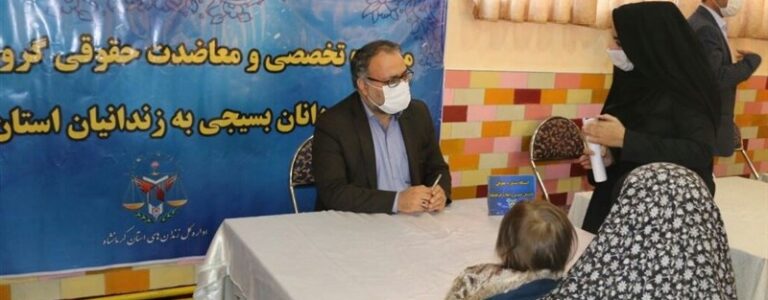
Feature Image: Tasnim News Agency, February 2021