
Originally published in Farsi at Radio Zamaneh on July 4, 2024
Hamed Farmand, President of Children of Imprisoned Parents International and a member of the Global Prison Nursery Network
Young children, breastfeeding mothers, and pregnant women are held alongside other women convicted of various public offenses in a facility known among inmates as the “exile prison.” This is a location where some female prisoners from other cities and provinces are transferred as a form of punishment. This report focuses on the conditions of this prison, particularly the situation of young children, their mothers, and incarcerated pregnant women. It is part of a series of reports I have published with Radio Zamaneh on the conditions of children and mothers in Iranian prisons and women’s wards, including reports on Kachooyi Prison in Alborz province (October 19, 2023), Sepidar Prison in Khuzestan province (October 26, 2023), Qarchak Prison in Tehran province (November 27, 2023), Urmia Prison in East Azerbaijan province (January 18, 2024), Lakan Prison in Gilan province (February 17, 2024), Vakilabad Prison in Khorasan Razavi province (March 16, 2024), Yasuj prison in Kohgiluyeh and Boyer-Ahmad province (July 4, 2024), and Evin prison in Tehran province (September 5, 2025).
To prepare this report, I interviewed Fatemeh Khoshroo, a former political prisoner who was incarcerated in this facility in December 2019 and reviewed her posts on X (formerly Twitter). I also obtained information, through intermediaries, from other former inmates who were imprisoned there in later years. Additionally, I utilized official data published on the website of the Iranian Prison Organization and reports from news agencies such as IRNA, Mehr, Fars, and Khorramabad, as well as the human rights website Hrana.
The reports compiled have been translated into English by Radio Zamaneh or the Children of Imprisoned Parents International (COIPI) and have been shared with the Global Prison Nursery Network, implemented by the Children of Imprisoned Parents International (COIPI). This project aims to raise awareness about the conditions of children in prisons worldwide and advocate for their welfare by prioritizing their best interests.
Life in Prison Mirroring Life Outside: Living in Poverty and Helplessness
Rule 51 of the United Nations Rules for the Treatment of Women Prisoners and Non-Custodial Measures for Women Offenders (commonly known as the Bangkok Rules) emphasizes:
“The environment provided for the upbringing of children (accompanying their incarcerated mothers) should be as close as possible to that of children outside prison.”
This set of rules, adopted by the UN General Assembly in 2011, serves as a recommended standard for member states. However, several activists and former prisoners have told me that, given the conditions of the families of incarcerated women outside of prison, the situation of these children outside prison is, at best, no better than within.
These children often face poverty, lack of access to educational and recreational facilities, and, in some cases, the addiction of their caregivers. Some are even born into addiction. However, according to the Bangkok Rules and other international documents, including the UN Convention on the Rights of the Child, governments are responsible for ensuring the livelihood, health, and developmental needs of children. When governments fail in this responsibility, many women and men, instead of receiving supportive services, find themselves incarcerated. Yet, prisons themselves fall far short of the minimum standards set by the UN, exposing children to even greater risks.
Some incarcerated women, due to rejection by their families, their families’ financial struggles, or their exile to distant locations, are unable to provide for themselves or their children.
The exact number of children and pregnant women currently held in the women’s wards of Khorramabad Central Prison is unknown. However, based on testimonies from former inmates and official reports, children have been held with their mothers in this prison since at least 2012.
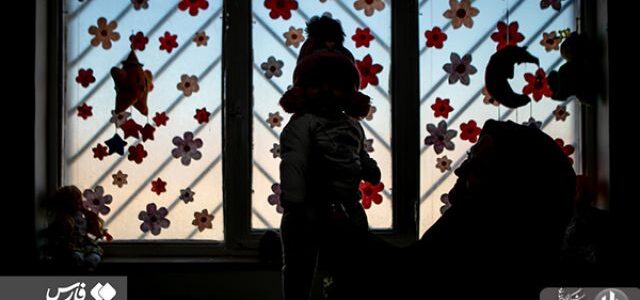
In a photo published by Fars News Agency on January 25, 2022, showing a child in their mother’s arms silhouetted against a window adorned with decorations, the caption claimed:
“A nursery exists in this prison.”
No other reports confirm the existence of a nursery, nor has this claim been independently verified. Fatemeh Khoshroo, who was imprisoned in December 2019, refuted this claim in a May 2024 interview, stating:
“There were no toys or recreational facilities for children in this prison.”
According to Khoshroo, even basic provisions like diapers and formula were not supplied to mothers. She described a child who “cried constantly from hunger.”
While the head of Lorestan’s prison administration described the relationship between Ms. Bohlouli, the head of the Women’s Ward and the Rehabilitation Center at Khorramabad Central Prison, and the “children in the ward” as “friendly and maternal” during a press conference on June 29, 2017, the absence of independent media and transparent field research highlights the importance of eyewitness accounts. Similar reports of mistreatment of inmates by prison officials in other facilities have also surfaced.
The following sections will address the general conditions of the women’s ward at Khorramabad Central Prison, including hygiene, nutrition, and mental health. These are conditions that, despite international recommendations such as the Bangkok Rules, are also experienced by young children, breastfeeding mothers, and pregnant women.
Cleaning with Contaminated Water and Living in a Dull Environment
Female inmates at Khorramabad Central Prison were transferred in December 2008 to the former Juvenile Rehabilitation Center of Khorramabad. The justification for this transfer was the aging condition of the Central Prison and the harsh conditions it imposed on prisoners. However, transferring women to a facility not originally designed for female inmates underscores the Iranian authorities’ disregard for the specific rights and needs of women in custody. Notably, the construction of a new prison building for the 90-year-old Central Prison was reportedly initiated in 1999, with plans to allocate an independent ward for women. Yet, even if a separate ward had been built, it is uncertain whether it would have adhered to international standards[1] for housing women, including pregnant women and mothers with children.
According to Fatemeh Khoshroo, who was imprisoned there in December 2019, the women’s section of Khorramabad Central Prison housed over 80 inmates at the time and consisted of two wards. Ward One, with approximately 30 square meters, was designated for drug-related offenses, while Ward Two, about 40 square meters, housed inmates convicted of financial crimes, theft, or murder. Both wards were overcrowded, with many inmates, particularly in Ward One, sleeping on the floor due to insufficient space. During that period, Ward One housed three pregnant women and an infant with its mother, while Ward Two held two pregnant women.
The water used for cleaning in the women’s ward comes from a well and is so contaminated that, according to Khoshroo, worms and cockroaches sometimes crawl onto inmates’ bodies during showers, making them feel as though their skin is “peeling off.” Of the three shower stalls available, one was “always broken.” Filtered water, while available, had an unpleasant taste. The prison food was described as unappetizing and often contained hair. Fruits and vegetables were provided only once a week, and the prison store lacked variety in its offerings.
Medical care was inadequate, especially for pregnant women and mothers. Khoshroo recounted the case of a seven-month pregnant inmate who suffered from gastric reflux and gynecological infections but was repeatedly denied access to the infirmary or hospital under various pretexts.
The lack of sports equipment, recreational activities, and appropriate books[2] turned the prison into a monotonous and oppressive environment. Most inmates gained excessive weight due to the poor diet and lack of physical activity. According to Khoshroo, fights among inmates and acts of self-harm were common. Violent altercations, such as throwing boiling water flasks, often occurred, even in the presence of children.
While overcrowding, the absence of recreational, educational, and sports facilities, and psychological pressure are issues reported in most prisons, Khorramabad Central Prison’s women’s ward stands out for its additional restrictions under the leadership of its director, Ms. Bohlouli. Khoshroo described how strict prohibitions on dancing, celebrations, and wearing clothing deemed inappropriate—such as sleeveless tops or garments that revealed the contours of a woman’s body—turned the environment into “a prison within a prison.”
What Can Be Done to Save the Children?
Each time we document the conditions of children held in one of the country’s prisons, we repeat the same pressing question posed in the comprehensive report prepared by the Children of Imprisoned Parents International:
What can we do to save children from the conditions they face in prisons and women’s wards in the country, while preserving the rights of incarcerated women?
As members of civil society, activists, and journalists, it is crucial to be aware of prisoners’ rights in general and the rights of incarcerated women and children in particular. This includes understanding international mechanisms designed or proposed for housing children with their mothers (or fathers) in prisons, as well as drawing on global experiences.
The Children of Imprisoned Parents International, as a member of the Global Prison Nursery Network (GPNN), strives to document current conditions in Iran, raise awareness about the rights of incarcerated children and mothers, and share global experiences. Alongside other members of this network, GPNN works to design and advocate for more precise minimum standards tailored to the best interests of children at the international level.
For this reason, obtaining accurate, up-to-date, and well-documented information about the conditions of children in prisons and women’s wards in the country is of significant importance. Human rights organizations, media outlets, and former inmates reporting on the conditions of women’s prisons in Iran can play a vital role. By providing precise information on the number and conditions of children in these facilities, they contribute to documentation efforts and pave the way for substantial steps toward improving the situation for incarcerated women and children.
Feature Image: Fars News Agency, Mohammad Mehdi Pourarab, January 25, 2022
[1] Including Rule 5 of the United Nations Rules for the Treatment of Women Prisoners and Non-Custodial Measures for Women Offenders (commonly known as the Bangkok Rules).
[2] In July 2022, news of the inauguration of a library in this prison was published. However, as with other official reports, this claim neither aligns with inmates’ testimonies nor can it be independently verified.